No products in the cart.
Top

``Water has the taste of the gift of song that blows from memory's gardens.`` Mahmoud Darwish

TERRAIN OF MY DREAMS

Curatorial Statement

To dream is many things. As we fall into darkness behind our closed eyes other worlds arising from inside of us may be interpreted as a fantasy or an omen, lost memories or future desires. What we encounter may propel us beyond our wildest imagination or scare us into inertia. The stuff of dreams has always been a preoccupation; in every human epoch and culture they inform our waking reality.


Their potency may even feel hyperrealistic. Dreams have a dense sensual quality, a viscosity that sticks with us as we enter into our day. And for this reason, they provoke our attention.


What are these worlds we find in that semi-lucidity between awakeness and an unconscious tabula rasa waiting for night to write the day’s impressions onto our mind?


Where are these worlds? The blended landscapes with their composite structures and cast of characters, known and unknown?


And why do these worlds so evocatively permeate our interior?


The dream terrain is an emotional landscape, one of embodied memories not fully understood, remaining unknowable waiting for other lifetimes. Perhaps the why isn’t as imperative to know as to how embarking on the journey can lead to other realities and futurities; assist in a solution, provide an escape, soothe a longing.


Each of the selected artists has illustrated a terrain for an audience. The terrain may be connected to ancestral lands, a place loaded with sentiment, a constructed utopia, a repetitive nightmare or all of these things together as dreams are often vaporous in their interpretation. Terrain of My Dreams demonstrates the world building of artists and their ability to alchemize what comes forth from the threshold of the unconscious creating new places for us to come upon.

Selected Artists

  • Mohammad Alfaraj, The Date Fruit of Knowledge, 2022 (website)
  • Sama Alshaibi, Prelude to a Round City, 2023 (website)
  • David Gumbs, Ethno Spirits Martinique, 2023 (website)
  • Lisa Jackson, Biidaaban: First Light, 2018 (website)
  • Olalekan Jeyifous, Even in Arcadia: From Brooklyn to the Hudson Valley, 2024 (website)
  • Lotus Kang, Azaleas II, 2024 (website)
  • Kara Springer, The Earth & All Its Inhabitants, 2019 (website)

Context

Terrain of My Dreams is also about light. More specifically, luminosity as a type of artistic medium; the emanation of light from a screen or digital interface as an essential part of the production of the art work. And darkness. The exhibition makes use of the necessary absence of light as a way to bring focus to each artist’s work as it radiates from its technological apparatus. Within the exhibition, artists either use emerging digital technologies, integrating interfaces, screens, and VR headsets into their work, or reach back to analog film and processes. The interplay between them all becomes a way to observe a lineage of image-making, and its connection to storytelling about place, as technologies change. They are all recent works bracketing a moment of contemporary art, 2018 to 2024, in the lead up to a global shut-down and the time proceeding as we move out of isolation into collective experiences again. 


The immersive potential of black boxes, video screens, projectors, Virtual Reality (VR) headsets and other digital devices is becoming more accessible to artistic practice. The art world has been slow to embrace video and digital art but as successive generations of digital natives become the audiences as well as the creatives behind the work there is more acceptance and understanding of the technologies. That is not to say that the use of moving pictures is new or novel within the arts. From the Surrealists to the Russian Avant-Garde, film and its projection onto screens, or other surfaces, was part of modernist art making and seen as a way to deconstruct assumed ways of conveying narratives. As performance art gained momentum during the 1960s, film, then video, was used to document the ephemeral nature of performance. By the 1970s, artists such as Vito Acconci and Marina Abramović pushed the accompanying documentation of their performance art, through film and video, into the mix of Conceptual art. Korean artist Nam June Paik is known as the ‘Godfather of Video Art.’ His wife, Japanese artist Shigeko Kubota, also played a critical role in the emergence of video art in the New York art scene they were both part of from the 1960s onward. As with Kubota, women have been early adopters of electronic and digital technology as a way to address feminist issues in their practice, artists like Nalini Malani (India) and Pipilotti Rist (Switzerland). Such technologies, along with the exploration of scale, have also been the methods for articulation regarding the fracture that colonial disposition and displacement have caused. From Mona Hatoum’s (British-Palestinian) So Much I Want to Say installed as a small monitor on a floor to Rebecca Belmore’s (Anishinaabe) Fountain, where a water wall pours over a cinema size screen, the moisture creating its own atmosphere within the gallery space. South African artist William Kentridge and Ghanian-born London-based artist John Akomfrah have captivated audiences with their expansive multi-channel video productions that are spell-bounding with their immersivity.


This exhibition places the selected work within this short, yet ground-breaking, time in art history where conventions of established media are uprooted and new forms of exhibitional typographies are generated. Terrain of My Dreams traverses the multiple ways emerging technologies (Virtual and Augmented Reality, Photogrammetry, LiDAR) are used and considers how IRL objects and surfaces, such as plants in David Gumbs’ Ethno Spirits Martinique or sand in Mohammad Alfaraj’s The Date Fruit of Knowledge, become conduits for digitized content streams. For these artists, moving between analog and digital is naturalized into their practices. As Martinican artist David Gumbs shares:


By collapsing the boundaries between the intimate and the monumental, the visible and the invisible, I aim to create poetic technologies—immersive experiences that reconnect viewers to memory, place, and the urgent rhythms of a changing world.


The artists, local and global, offer us various ways to perceive the terrains they portray. Perhaps we recognize the landscapes, or quite possibly they offer something entirely unknown yet we feel a resonance with where they take us to.

 Project Objectives

As a speculative art exhibition, Terrain of My Dreams provides an opportunity to look at a contemporary art landscape arising from the 1960s onwards when electronic then digital technologies were adapted into artistic practices. The artists using such technologies created bodies of work that require a very different set of approaches for production, installation, engagement and conservation than more traditional art practices and art-making. As most of the artists selected for Terrain of My Dreams are using emerging digital technologies, assessing what might be the installation specifications allows for research on the nuts n’ bolts, the hardware and software as well as what kind of tool kit is necessary to install these types of exhibitions. It is also an opportunity to see if there are established workflows and best practice processes to learn from.

Installation Proposal

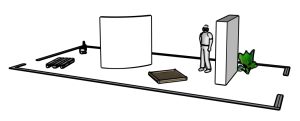
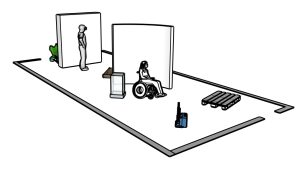
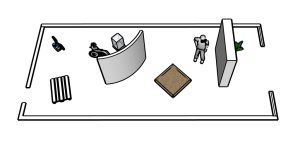
Terrain of My Dreams is adaptable for various exhibition spaces, although due to the need for reduced light, it is best suited to an indoor exhibition venue. As an exhibition proposal, it is mapped out for the Azrieli School of Architecture & Urbanism’s Lightroom Gallery and designed to be a smaller, more intimate engagement with the work. For this reason, larger works such as Prelude to a Round City, Azaleas II and The Earth & All Its Inhabitants include suggested amendments to the installs that maintain, even augment, the spirit of the work. The main specification is a darkened gallery space. The glass wall that fronts the entrance of the gallery would be covered with blackout curtains suspended from the ceiling or blackout film adhered to the glass; the walls painted to convert the exhibition space from a white cube to a black box.

A partial wall will be constructed and positioned at a shallow depth at the entrance to the gallery as the backdrop for Ethno Spirits Martinique. For Prelude to a Round City, a large curved frame will be installed in the centre of the gallery with scrim material stretched across to act as a screen with projections on both sides; a plinth with glass vitrine also installed to hold a maquette version of the work. Projectors and black lights will be secured to ceiling tracking. With the exception of the works that require VR headsets to view and hear the productions, Even in Arcadia and Biidaaban, only one other installation, The Date Fruit of Knowledge, has an accompanying soundtrack. The audio will filter into the gallery space intentionally as a story that binds all the work together. For wall text (i.e. Curatorial Statement, Didactic Panels, Titles, Instructions) white vinyl adhesive text will ‘glow’ with the effect of black lit projected onto the text areas.

View blueprints for ASAU’s Lightroom Gallery here.

Ethno Spirits Martinique

Technology: Projection Mapping, Augmented Reality
Specifications: Projectors, LED lighting, Black light, QR Code for AR app install and/or tablets available,tropical plants
Considerations: Front projection, with projector placed above entrance doors. Black lights mounted in either corner. As plants are living so they change shape, the projection mapping must be adjusted daily, along with the plant care (i.e. watering).


Ethno Spirits Martinique opens the show. With an animated projection mapping onto the broad leaves of a tropical plant the work invites the visitor to touch and engage as the light dances on the surface of the plant. A hedge of imagined foliage assembled of cutout paper shapes is placed in front of a wall that separates the installation from the rest of the exhibition found just beyond. A track of LED lights placed on the floor between the hedge and the wall continually transform the backlighting on the wall with oscillating colours as well light up the hedge from below adding more dimension. From above, a black light is timed to also spill onto the foliage providing a moonscape-like effect. The cutout landscape can also be engaged with interacting through an Augmented Reality (AR) app using a tablet or phone. This digital feature adds another layer of wonder and discovery for the visitor as activation spots open up animated digital objects with symbolic meaning. The original installation was inside a building at the Domaine de Fonds Saint-Jacque, a former colonial plantation on the island of Martinique. The backdrop behind the foliage was an interior rock wall. With the use of photogrammetry, a scan of a section of the wall of this historical building can be transported into the ASAU gallery space by projection mapping the scan onto the surface of the partition wall. With such types of projections, it is preferable to cover the wall with white paint that has mixed into it reflective particles (i.e. glass beads). This improves the gain, in other words the measurement of reflectivity (i.e. 1.0 is standard white) that occurs when reflective particles are mixed into a paint binder (i.e. increase to 1.2). This provides a surface that is optimized for refracting the light from the projector in such a way that the image’s brightness is improved beyond projecting onto a flat painted wall.

More about the work

Ethno Spirits vous propose d’entrer en dialogue avec les entités d’un univers végétal et sensoriel. 


Une aventure qui ne laisse pas indifférent ; une expérience qui transforme au-delà du visible.


L’artiste multimédia, David Gumbs, vous invite à ce voyage hors du commun où le vivant nous révèle sa part de fraîcheur et d’influence, de magie et d’aura.


Soyez à ce rendez-vous de l’art et au cœur battant de la création numérique.


Lauréat de Mondes Nouveaux pour la Martinique et Saint-Martin, David Gumbs nous entraîne dans un monde sensoriel de toutes les lectures.


Chaque œuvre est unique et chaque vécu singulier pour le plus grand bonheur de nos moindres sens.


Read more

More about the artist

For over two decades, my work has explored identity, memory, and belonging within the post-colonial Caribbean, where ecological fragility and historical trauma intersect. I create immersive, technologically advanced installations that blend generative video, interactive sound, and data-driven environments to turn public spaces into living, breathing archives of resilience and transformation.


Rooted in the Caribbean’s vulnerability to rising seas, hurricanes, and environmental collapse, my recent projects reimagine transatlantic narratives through speculative landscapes where light, motion, and sound awaken ancestral memory. I engage with the trauma and resistance embedded in Black and Indigenous ecologies, revealing unseen emotional geographies.


Read more

The Date Fruit of Knowledge

Technology: Video Projection
Specifications: Projector, Sound Dome Speakers and/or Audio Speakers, Sand
Considerations: If using a Sound Dome centered above the work the projector must be rigged below which depending on the decibels could cause vibrations that will impact the projector, thus impacting the projection with blurring; as the sand on the floor may shift with visitors accidental contact with the sand, the boundary of the sand as a projection surface will shift causing projection registration to spill on the floor beyond the sand.


Although VR headsets corresponding to two VR works will be hung on the partition wall, it is anticipated that due to light coming up from the projection on the floor of The Date Fruit of Knowledge, as eyes adjust to the darkness, visitors will be drawn to the work peering down at the scene below. Projected onto sand, the effect will be as though a hole has opened up within the black box exposing earth below the constructed surface of the gallery. The stop motion sequence introduces echoes of film animation into the space, bridging older analog techniques with emerging digital technologies. As with David Gumb’s Ethno Spirits Martinique the notion of care with regards to the natural material is important, daily checking to ensure the sand is contained within the boundaries of the projection area. Also, a decision to be discussed with the artist, must the sand be from the location being referenced within the projection? How does the meaning shift from a mise en abyme if sand from here is used as a proxy? What are the narrative layers added (or diminished) if such an adjustment is made? 

More about the work

Created in 2022 in the context of an artist residency in AlUla¹ , The Date Fruit of Knowledge marks the artist’s first use of stop motion animation. Employing very few material elements, AlFaraj invites us into an immersive video device, halfway between a live performance and its archive. To establish a mise en abyme, the artist superimposes Saudi soil – taken from his open-air studio – on a bed of fine sand placed on the projection surface in the vault of Mennour gallery. Recalling the techniques of haptic cinema through which “the eyes function as organs of touch” 2 ,  AlFaraj seeks to create the conditions for sharing the present moment. Hic et nunc. 


¹ The AlUla Artist Residency Programme was founded in 2021 as a collaboration between the Royal Commission for AlUla (RCU) and the French Agency for AlUla Development (Afalula). Its aims to bring together artists from diverse backgrounds, techniques and mediums and invite them to immerse themselves in the local culture, history and community of AlUla, an ancient oasis located in the Medina province of northwestern Saudi Arabia.

² Marks, L. U. The Skin of Film: Intercultural Cinema, Embodiment and the Senses. (Durham: 2000, Duke University Press), p.162.


Read more 

More about the artist

Mohammad Alfaraj is a multidisciplinary artist who works across filmmaking, installation, sculpture, writing and photography. Alfaraj’s work is anchored to place, specifically his home city of Al Hasa, where he was born and raised and continues to live today. As an oasis in the desert, Al Hasa supports existence in an otherwise arid environment. Alfaraj draws inspiration from this non-negotiable dependence of people upon nature, frequently deploying natural and indigenous materials found in the local landscape within his artworks; such as dirt, palm fronds and dates. The artist combines these materials with practices drawn from those who inhabit the same landscape, such as stories from local workers and children’s invented games, to reflect on the ways in which people and the natural environment affect each other, in both detrimental and positive ways. In this way, Alfaraj’s practice is balanced with a poetic vision and an undercurrent of hope.


Read more

Prelude to a Round City

Technology: Video Projection*
Specifications: Projectors, Frame with Scrim Screen
Considerations: Construction of double-sided screen; front projection on two surfaces, projectors mounted in ceiling on left and right side; adaptation of the original video production for multiple screens scaled down.


The initial commission was for a larger construction of several screens forming a circle within the exhibition space that was the Maraya Art Center in Sharajah, United Arab Emirates. For the Terrain of My Dreams install, a scaled down version is proposed with one screen operating as a structure that bifurcates the front and back of the exhibition, still providing an ‘architectural’ presence that suggests a built environment one might encounter in an urban street or rural settlement. Projectors must be able to be positioned far enough away to expand out onto the surface without causing the projection to go out of focus, what is termed the throw ratio. A small ‘maquette’ version of the larger install could be placed on a plinth in a glass vitrine to mimic museological installation practices that fix objects in time and create obstructions to tactile engagement.**


*Content created using LiDAR technology, the first time, outside of working with Jeff Thomas on The Scout Relocation Project that I have seen LiDAR technology used for an artist’s video production. 


**In working on the 3D model for the exhibition space it was evident that scaling the work down to one large screen is still too big for the space. I would propose to the artist another idea that incorporates the plinth and vitrine idea, to build a ‘black box’ within the black box of the gallery space that visitors enter in to see a model of the original, in the round installation as a maquette size and that works with the idea of a ‘god’s eye view’ of a location but also this idea of the static ancient heritage coming to life under the glass of the vitrine. 

More about the work

In Prelude to the Round City, Alshaibi appropriates the symbols and associations of Baghdad. The highly sentient material of daily city life saturates the installation through dense spatial records, forming significant and banal assemblages of meanings. On the one hand, the LIDAR scans are simply data measurements, the factual records of the physical environment, including the collapsing and preservation of sacred heritage sites and historic neighborhoods in rapid transition with the booming commercial development or crumbling in neglect. The scans illuminate the pursuit of everyday daily life filled with people moving across the urban terrain, the strain on the failing infrastructure with heavy traffic, making the outer margins of the city, such as simplicity expressed in the Mesopotamian Marshes and Milwiya Minaret, a utopic periphery. 


Read more

More about the artist

Sama Alshaibi works across image and installation, combining emerging technologies with historic processes to explore how the medium itself shapes what is seen, obscured, or remembered. Moving between photography, video, LiDAR scanning, archives, photogravure, and albumen printing, her projects highlight the ways images register both presence and disappearance, fact and speculation.


Alshaibi’s early practice positions her body as a site of performance, interrogating the social and gendered effects of migration and conflict. Her work complicates the visual coding of the Arab female figure within the image history of the Middle East and North Africa. Alshaibi’s sculptural installations function as counter-memorials to forced exile.


Read more

The Earth & All Its Inhabitants

Technology: Lightbox (approx 3 x 5 feet)
Specifications: Lightbox, rechargeable batteries, found material for support structure
Considerations: As per artist instructions, the lightbox is installed on a moveable cart made from found materials specific to this exhibition site. It is powered by rechargeable batteries that must be replaced every few hours, requiring tending to throughout the day for the luminosity to remain vibrant. 


As with The Date Fruit of Knowledge, this work is another bridge from analog to digital as it replicates the lightbox display device artists used in the presentation of analog photography. With such a device, the image, often originally photographed on transparency (slide) film, would be scaled up using an enlarger then developed using a wet chemical bath. Now digital images can be printed on a semi-transparent material using a digital printer, a dry process. Lightboxes typically use electric outfitting and require an electrical outlet for the cord. The Earth & All Its Inhabitants uses battery powered LED lighting. Unlike conventional lightboxes used in gallery settings adhered to a wall and only viewable from one side, this lightbox is viewable from both sides. Also, it is to be installed on a moveable cart constructed with found materials within proximity to the exhibition location. The artist is interested in thinking about notions of place as well as care. What does that mean within a gallery space, within an arts community? To think through the labour that accompanies a static work is an intentional aspect of the work, one that connects it with the plant in Ethno Spirits Martinique and the sand in The Date Fruit of Knowledge.

More about the work

Springer’s The Earth & All its Inhabitants presents a ladder placed in a body of water, falling just slowly enough to be photographed. This image documents an actual event orchestrated by the artist in the Atlantic ocean of the Bahamas, aligned with other fragile, minimal sculptures that she positions within landscapes and public spaces. Again, natural forces (in this case gravity) weigh on her structures, ruining them in an instant or gradually over time. Through Springer’s documentation, however, we witness these objects’ defiance against their new conditions, their ability, even for a second, to suspend the inevitable and our disbelief.


Physically, the photograph is mirrored and double mounted on either side of an industrial lightbox. The work is scaled to Springer’s body so that she can carry it around, and at the same time, she notes, “It is beyond the comfort of what I can manage with my body.” The lightbox is installed on a moveable cart made from found materials specific to this exhibition site. It is powered by rechargeable batteries that must be replaced every few hours, requiring tending to throughout the day to remain vital, glowing.


Springer’s photograph—its imagery and—sustains a sense of ambition, hope and the celestial shared across cultures through the ancient proverb of “a ladder set against the sky.” It also invites its handlers and beholders to engage in questions around care.


Read more

More about the artist

Kara Springer is particularly concerned with armature—the underlying structure that holds the flesh of a body in place. She works with photography, sculpture, and site-specific interventions to explore systems of structural support through engagement with architecture, urban infrastructure, and systems of institutional and political power.


Read more

Azaleas II

Technology: NA
Specifications: Vertical track lighting, fan, motion detector
Considerations: Does the work require human intervention to turn the wheel or is the wheel automated by a concealed electrical device or automated by a fan? Vertical track lighting will need to be installed as a less technical form of projection than the use of a projector as with some of the other works. 


This work is the literal insertion of analog film into exhibition. Transparency film is wound around a structure modeled after industrial rotary dryers that were used to dry film before developing them in a chemical bath. As the structure rotates, lights positioned behind create a type of  projection of the transparency film onto the floor and wall. For installation at ASAU a smaller scale version would be adaptable to the space with a motion detector triggering a fan that moves the dryer forward or an electrical device that automates the rotation. Another adaptation could be one like the initial object the artist discovered that led to the building of larger replication, one that is simply rotated by hand. Either this adaptation or the motion sensor utilizes the body of the visitor as a way to activate the installation, a form of engagement either through touch or through mere presence. 

More about the work

When you turn away from seeing me

and go,

gently, without a word, I shall send you away.

From Mount Yak in Yongbyon,

azaleas,

I shall gather an armful and scatter them on your way.

Step after step away

on those flowers placed

before you, press deep, step lightly, and go.

When you turn away from seeing me

and go,

though I die, no, not a single tear shall fall.¹


Published in 1925 during the period of Japanese colonial rule over Korea, Azaleas (Jindallaekkot) is a poem by the late Kim So-wol written from the perspective of a woman to describe the separation of a pair of lovers. Perennially featured in textbooks, adapted to songs, and interpreted in myriad ways over time, the poem has become an icon of Korean identity and renowned for its poignant expression of loss and longing.


Kang’s Azaleas is an installation inspired by a rotary film dryer, consisting of a six by eight foot rotating drum, lights, 35mm film, wind chimes, and sound. Synchronized to the meter of Kim So-wol’s Azaleas (in Korean) and two lines from Kim Hyesoon’s poem, Face (in English), the drum spins forwards and backwards to a score born out of compression and translation. Each sequence of the drum’s rotations affects a simultaneous sense of disorientation and rooting; the poets’ words haunt in their absence while Kang’s own explorations of loss and lack permeate into the dark gallery. Made with crude construction materials including steel and aluminum, the central drum conjures an exaggerated rib cage–bound horizontally by hundreds of feet of celluloid film, and projecting an orbit of skeletal silhouettes onto the walls.


While originally intending to film azalea blossoms at the Brooklyn Botanic Garden, due to the time of year, Kang was only able to capture rose bushes (images of which are now imprinted on the work’s 35mm celluloid). This accidental form of loss initiated thinking around the irrecuperable, both in terms of memory and desire; as a result, there are no azaleas that appear anywhere in the exhibition.


¹ Kim, So-wol. Azaleas, Translated by David R. McCannColumbia University Press, 2007.


Read more

More about the artist

Lotus L. Kang’s practice unfolds across sculpture, photography and site-responsive installation. Using an acute sensitivity towards process and space, her work reflects on impermanence, inheritance, memory, and time. Taking up questions of “becoming” on expansive terms, she often uses unstable and unfixed materials in a visual language that melds structural, organic and entropic forms to explore self and environment as contingent, continuous and inseparable.


Kang often engages these concerns through material misuse and transformation, working with media such as photographic paper and film whose light-sensitive surfaces accrue traces of their environments—architecture, bodies, humidity, light. Lengths of unfixed industrial film—”skins” as Kang calls them—drape over built structures or hang from the ceiling, their shadowy markings creating layered timescales that speak to organic, visceral and leaky forms, rendered in a palette of blood, bruise and bile.


Kang’s materially dense, non-linear installations metabolize and translate themes drawn from industrial and architectural forms, familial and social histories, poetry, and non-human figures, among others. Fluid and web-like, her elegantly disordered and continually sensitive scenes refuse to settle or congeal, ever in a state of in-between. They speak to the fundamental instabilities of memory, history, body, identity: What is passed down and what is lost? How is time known in the body? What is preserved and what is destroyed?


Read more

Even in Arcadia

Technology: Virtual Reality (VR)
Specifications: VR Headsets
Considerations: VR Headsets can be cumbersome for the visitor to both put on and to operate. Settings for the headset can be adjusted for public settings that create less issues, for example automated triggering of content to start once placed on a body and/or headsets with minimized external buttons and  interactive features. Regardless, inevitably these applications can fail to operate optimally. Does a digital exhibition require a docent to be present in order to facilitate that experience to be a positive engagement?


VR headsets corresponding to each work will be hung on the back of the opening partition wall. Both VR productions present speculative worlds yet are set within real locations, urban spaces within major urban centres, New York City (Even in Arcadia) and Toronto (Biidaaban). Within the worlds the artists present are signifiers (architecture, structure, art and culture) along with audio and visual codes that allude to other worldviews that may offer counter positions to the dominant ones. They are both examples of how emerging digital technologies play a part in conveying ideas about the future imaginary and world building. They are also examples of the power of VR environments to present some of the most deeply immersive experiences of an artist’s world.

More about the work

Amid evolving environmental and cultural shifts, there emerges a space for thoughtful yet whimsical reflections on an increasingly challenging reality. The tensions between our natural and built world—amplified by intensifying climate conditions—form the backdrop for Olalekan Jeyifous: Even in Arcadia… Drawing inspiration from the Arcadian myth, the exhibition juxtaposes picturesque portrayals of idyllic pastoral life with glimpses of a retrofuturist urban protopia set within the Hudson Valley. In leveraging both the artistic and literary motifs of Arcadia, the exhibition engages us in considering the possibilities and challenges posed by an inventive world-making process that is simultaneously shaped by the polished echoes of historical ideals, contemporary socio-political anxieties, and the uncertainty of our future aspirations.


Arcadia, historically regarded as an emblem of bucolic tranquility and unspoiled wilderness, is creatively reinterpreted in the eclectic assemblage of photomontages, experimental video, and small-scale sculptures on view. Depicting a community of characters, spaces, and objects that populate a rich fictional world, Jeyifous provides a window into a dense, multifaceted narrative. The works artfully weave the promising ideals of solar/salvage punk—themes of renewable energy, environmental sustainability, the imaginative repurposing of post-industrial detritus, and the transformative re-wilding of [ex]urban spaces—into an irreverently evocative fever dream.


In addition to referencing the visual motifs of retrofuturism and solar/salvage punk, the exhibition also engages with the contentious history of the Hudson River School, a landscape painting movement active in the mid-19th century. By contrasting bucolic renderings of Hudson Valley landscapes with a nuanced, sustainable model for a post-industrial community in the region, Jeyifous satirizes the art movement while mapping his vision for a productive and fruitful relationship between the land and its inhabitants.


Jeyifous’ pluralistic relationship to futurity is informed by a protopian growth model. Rejecting the fixed paradigms of utopian thought, the exhibition instead presents an alternate timeline while recognizing the continuous, messy, and iterative process necessary to move toward more equitable societal structures. Through this protopian lens, Jeyifous’ work interrogates the potentialities of harmonizing reconstituted technological advancements alongside ecological stewardship.


Read more

More about the artist

Olalekan Jeyifous received a BArch from Cornell University and is a Brooklyn-based artist whose work re-imagines social spaces that examine the relationships between architecture, community, and the environment. He has exhibited at esteemed venues including the Studio Museum in Harlem, the Vitra Design Museum, the Guggenheim in Bilbao, Spain, and the Museum of Modern Art, where his artwork is featured in the permanent collection of the Department of Architecture and Design.


In addition to an extensive exhibition history, Olalekan has spent over a decade creating large-scale installations for a variety of public spaces and was co-commissioned to design a monument for congresswoman Shirley Chisholm as part of the City of New York’s “She Built NYC” initiative.


Read more

Biidaaban: First Light

More about the work

The town square is flooded. The city’s infrastructure has merged with local flora. In this radically different future, people have found a connection to the past. Biidaaban: First Light illuminates how the original languages of this land can provide a framework for understanding our place in a reconciled version of Canada’s largest urban environment.


Read more

More about the artist

With a background in documentary, Lisa Jackson expanded into fiction with SAVAGE, which won a Genie award for Best Short Film. She’s known for her cross-genre projects including VR, animation, performance art film and a musical. Playback Magazine named her one of 10 to Watch and her work has played at festivals internationally, including Berlinale, Hot Docs, SXSW, Tribeca, and London BFI, as well as airing on many networks. Her short film LICHEN, created in IMAX, screened at Sundance in 2020.


Her NFB VR work BIIDAABAN: FIRST LIGHT premiered at Tribeca, has exhibited to 25,000+ people around the world, won a Canadian Screen Award, was nominated for a Webby, and has garnered high praise from press and the public. TRANSMISSIONS, a 6000 square foot multimedia installation on the power of language, premiered in September 2019 at SFU’s Milton Wong Theatre in Vancouver, was a cover story of The Georgia Straight and will continue touring. UNEARTHED, a film component from the installation, was featured at the Art Gallery of Ontario for Nuit Blanche. In 2017 she co-directed and co-produced the CBC one-hour doc INDICTMENT: THE CRIMES OF SHELLY CHARTIER which won Best Doc at imagineNATIVE and is one of the top-watched CBC docs online.


Read more

Technical

Due to the fact I was unable to find literature on digital exhibition design from the perspective of a gallery, exhibition designer, curator, installer and/or artist I had to go beyond the visual arts to find information that would be applicable. I gathered a lot from looking at set design for theatres, music video production, as well as consumer product reviews, most of this sourced on YouTube channels dedicated to topics such as image mapping, lighting, and the best projector, screen or TV to purchase for home theatres. Within this mix, I was able to follow bread crumbs to other possibly valuable information then cobble together a production plan. Despite the circuitous route to all of the information, it was a beneficial deep dive into understanding the hardware and software of emerging digital technologies. I was able to think about how I might apply what I have discovered to my own design practice to increase my digital offer for my climates. Of particular interest is image or projection mapping as well as the imaginative ways to use transportable screens or other surfaces, out and within landscapes, for memorable art encounters. 


With regards to Terrain of My Dreams, information regarding monitors became irrelevant as none of the art works required that kind of hardware setup. It was helpful though, to understand the difference between LCD / LED technology vs OLED technology. How a monitor is constructed (i.e. Edge Lit plasma TVs) can be an issue if a monitor is required to be on for long periods of time. This type of monitor is lit from below, the internal lighting around the bottom edge. This causes the edge to become hot with excess use. Such a monitor would not be appropriate for continual display during the duration of an exhibition. Direct Lit monitors do not have this issue but they are not good for black levels. Full Array Local Dimming technology was created to solve this problem, a grid of LED backlights are not on all the time as the grid gets broken down into zones (i.e. for a moon shot the moon is lit up the black areas turned off in the grid). Trimluminous technology costs more but is best for blacks and contrasts, concerns that may be important for artists. OLED technology is both superior and more costly with Four Stack or Tandem OLED TVS that have Quantum Dot technology providing the most dazzling display with regards to brightness and colour but coming in at the highest price point. For smaller arts venues, superior monitor technology may be out of reach impacting the display of artist works, although, for some artists, the brilliant colour and contrast may not be their aesthetic choice, older models may be more conducive to displaying video productions as per their specifications. An analogy would be the individual characteristics of certain analog film, some warmer in tones, other cooler. 


With regards to projectors, similar concerns of brightness and contrast come into play and of course, better quality equates to increased costs. If the venue is smaller, mid-range monitors might be sufficient as the projection is not required to light a great screen at a distance. There are other specifications to consider along with the throw ratio, the term for projection distance. The brightness is measured in Lumens (i.e. lower range projectors are 2000 Lumens, higher end range up to 72000 Lumens). 1080 p provides a surface projection of 1920×1080 pixels which can be sufficient for smaller spaces. The professional standard for exhibitions or immersive experiences (i.e. immersive Van Gogh) is 4K (Ultra HD) which expands to 3840×2160 pixels. If price is of concern there are softwares (i.e. DaVinci Resolve) that will extend 1080 p monitors to 4K range but with some loss of quality. Having a monitor that includes a bottom mount option is important for exhibition installations that require the projections to come from above rather than coming straight at the wall from a projector closer to eye level. This is important for ensuring the angle of the light does not result in hotspots (too bright and faded out) or blurring of the edges. 


Whether it is a projector or a monitor, these types of technologies are demanding electronically. If the electrical outfitting is not suitable within the venue space or location these types of art works are unsuitable. Tracking lighting is also important as well as the tracks and rails to mount and suspend projectors and auxiliary lighting. These installation requirements can limit the types of venues that can support digital art works exhibitions. In assessing the proposed layout for Terrain of My Dreams in the Azrieli School of Architecture & Urbanism’s (ASAU) Lightroom Gallery, the requirements were sufficient. In rendering the proposed layout in a 3D model (SketchUp) it was revealed that there is not enough room for the throw ratio to extend as far as the projector needs to be for a work like Prelude to a Round City, even if the original installation is drastically reduced. There could be other ways to display the work, as suggested in the Installation Proposal above. For this type of work, projected onto a large scrim stretched on a freestanding structure, there is also the possibility of projecting onto a wall surface, although the concern would be that it drastically reduces the meaning of the work to flatten it. Other types of screens, suspended from the ceiling but at a distance from the wall, could be a consideration. Screens, like monitors, also have variables to consider. A white screen (or white wall) is not always the best choice for a projection surface. Refractive particulates, whether added to a paint binder, or adhered to paper that can be mounted on the wall or other surfaces, assist with the displacement of light. In considering set design for stages, certain screens and lighting will create a hot spot in the middle, even a ‘transparency’ where the audience can see through the screen. Audiences at the sides may have a view where the projection is degraded and less visible. Screen materials, like OPTIBLACK PVC, can reduce these issues and are amenable to front or back lit projections. The right type of projection material is important for an art work like Prelude that is projected onto both sides. In all, one of the most surprising things I discovered through this technical deep dive was that a white painted wall is not really the best projection surface. If I think back to a lot of digital video projections I have seen installed over the years, now I know why something wasn’t making sense visually. 


As with the hardware and software, an appropriate tool kit for such installations can be cost prohibitive not only to the individual artist but also for smaller galleries and artist-run-centres. In the columns below I have aggregated lists for each. 


Hardware: projectors, screens, and monitors as well as the hardware necessary to program and run them, such as computers and media servers; lighting.


Software: software necessary to produce the art works as well as the software and applications to facilitate the installation of such work.


Kit: construction tools usually contained within a toolbox as well as other odds and ends that can be helpful rigging up the supports and structures that hold and contain the art works.


…and of course a first aid kit.

HARDWARE

  • Laptop and/or Tablet*
  • Media Server
  • Projectors
  • Scanners
  • Speakers
  • Sound Dome
  • Remotes (for Projectors, Monitors, Lighting)
  • Digital Sensors
  • Lighting 
  • Diffuser
  • Tripods (For Camera, Projectors & Lighting)*high-performance mobile workstations or premium gaming laptops with powerful dedicated graphics card and lots of RAM

SOFTWARE

For Production: 

  • Photoshop (Image/Video)
  • Illustrator (Image/Video/Mapping)
  • Premiere (Video)
  • AfterEffects (Video / Mapping)
  • Blender (3D Rendering)
  • Maya (Video, Animation)
  • Unity (Game Engine)
  • Unreal Engine (Game Engine)
  • Audition (Audio)


For Installation Layout:

  • Sketchup
  • Revit


For Setup:*

  • MadMapper
  • HeavyM
  • Resolume Arena
  • Touchdesigner


Misc:

  • Cloud Storage
  • Website Hosting with CMS (Content Management System) application
  • (i.e. WordPress, SquareSpace)


*VR Headsets come preloaded with the application

KIT

For Digital:

  • Cloud Storage
  • Roaming Router / WiFi
  • Media Server
  • Laptop
  • Battery Chargers
  • Electrical Extension Cords
  • Adapters
  • Cables (Video Graphic Array (VGA), High-Definition Multimedia Interface (HDMI), Digital Visual Interface (DVI), Universal Serial Bus (USB))
  • Small projector (for maquette setup)
  • Outlet Tester


For Construction:

  • Measuring Tape / Ruler
  • Tape (Duck, Electrical, Paint, Masking)
  • Scissors
  • Utility Knife
  • Flash Light
  • Leveler
  • Studfinder
  • Nails / Screws / Drill Bits
  • Allen Key Set
  • Hammer
  • Screwdriver
  • Drill
  • Saw
  • Pliers
  • Crowbar
  • Wrench
  • Wood shims
  • Paint Brushes / Rollers / Edgers
  • Paint Stirring Stick
  • Paint lid opener
  • Stepladder


Screens: 

  • Muslin / Scrim Fabric
  • Blackout Cloth
  • White Paint
  • Particulates (silver or glass beads to add to paint for painted projection surfaces)
  • Other screens specific to the projection requirements


Misc: 

  • Lighting
  • Plastic Sheetings
  • Bags
  • Lens Cleaning Fluid
  • Clothes / Rags

Conclusion

“Why digital art?” is a question proposed differently post-research, rather, “Why not digital art?” Embarking on such a project I had awareness that scholarship on the subject of digital art was sparse yet how sparse was shocking given digital technologies’ omnipresence in our lives. We inhabit a terrain that is networked; even our dream-time is cybernated as smart phones monitor our sleep cycles. My own dreams are mixed with motifs of the watery landscapes of rivers and lakes but also interfaces. There in dark semi-lucidity, screen interfaces become at once portals to new worlds as well as nightmares of dysfunction, as devices malfunction and communication becomes impossible. These dreams take on hazy meanings, always intriguing in waking contemplation. On the subject of artists’ depictions of landscape and dreamscapes much has been written. On the subject of artists using digital media to convey their imagined worlds, there is much less. Regarding scholarship on exhibition design that considers digital technologies, emerging or otherwise, there is almost nothing let alone critical art theory on artists’ use of these technologies. In many art movements, like Abstract Expressionism, art critics have played a crucial role in defining the times and contextualizing art-making within them. Artists interpret where we are as well as offer foresight as to where we are going. 


Aside from what might be the social impacts of digital art and art exhibitions, there are also other considerations. When there is no such thing as ‘the original’ work, what happens to the multiple facsimiles out there, languishing on various hard drives and clouds? How does this impact authorship or consent? In the past, artists kept duplications to a minimum. Certainly sending out a high resolution reproducible file was not the standard; now an image sent via text can be enlarged without much pixel degradation. We live in a time where it is an accepted fact that what is put out in the physical world will also be put out into the virtual world. It is strange to recall that in recent history, museums and galleries did not allow photographs for copyright reasons. Photography was also not allowed due to degradation of a camera flash, necessary in dimmer lighting conditions, on art works. In considering the subject of conservation, digital art is a thorn-in-the-side of art conservators which then impedes acquisitions as institutions don’t want to touch works with such sensitive technological systems. There is the risk that the work will become unviewable in a future moment when operating systems, software, and hardware no longer support content and file extensions. In my career as a digital designer, I have seen this multiple times, most notably when the introduction of Apple iPhones ushered in the smart phone era with internet connectivity on a handheld device. In a short time, Macromedia’s Flash, a software that many designers and developers used to build engaging interactive website content was unsupported on iPhones. Websites now had to consider responsive design, scaling to whatever device the viewer was using, along with smart phones, also tablets and notebook laptops. As designers and developers transitioned websites to these specifications web browsers eventually discontinued the necessary plugins to continue to run Flash-based websites. Within time, my own legacy projects became unviewable, as though never having existed. Ironically, the only way to view any interactive digital content made with Flash would be to have a computer running on an old operating system that supported the software and physically requiring the viewer to be present in front of the screen. Even analog technology has proven more stable. Regarding digital technologies, we often accept and don’t dissect. Post-lockdown the unformed rush to adapt without question is even more subscribed in our lives. 


The search for recommendations was not straightforward but there was much value in the pursuit of it all. It would be of benefit to have more resources. The journey to find and aggregate the information also revealed how in a world where almost anything technical you need an answer to is on YouTube, it was unexpected that so little was out there. The lack of resources on immersive and/or digital exhibition design, let alone conventional exhibition design, was unexpected. Perhaps Terrain of My Dreams will become a research project in several parts, but within this speculative exhibition proposal, the focus is on the foundational elements that this type of project requires, the practical and logistical specifications for installation. As no literature or documentation could be found with regards to workflow processes and best practices the deficit provides an opportunity for my own scholarship. 

Bibliography

Almeida, N. (2012). Dismantling the Monolith: Post-Media Art and the Culture of Instability. Art Documentation: Journal of the Art Libraries Society of North America, 31(1), 2–11. https://doi.org/10.1086/664932

Barnhart, B. (2021). Break the Internet: the rising popularity of glitch art. Linearityhttps://www.linearity.io/blog/glitch-art/ 


Bishop, C. (2012). Digital Divide: Contemporary Art and New Media, Art Forum (pp. 434 – 442)


Bruno, G. (2020). Surface Tension, Screen Space. In S. Ø. Sæther & S. T. Bull (Eds.), Screen Space Reconfigured (pp. 35–54). Amsterdam University Press. https://doi.org/10.2307/j.ctv12pnt9c.5 


Business Wire. (2020, February 10). Digital Art Exhibit “ETERNAL”, Inspired by Japanese Culture and the Concept of Time, Was Exhibited at Haneda Airport. https://www.businesswire.com/news/home/20200210005372/en/Digital-Art-Exhibit-ETERNAL-Inspired-by-Japanese-Culture-and-the-Concept-of-Time-Was-Exhibited-at-Haneda-Airport 


Campbell, D. (2003). Cultural Governance and Pictorial Resistance: Reflections on the Imaging of War. Review of International Studies, 29, 57–73. http://www.jstor.org/stable/20097885


Canuel, S. (2021, March 30). A beginner’s guide to exhibit design: Exhibition design is a world of its own. RGD. https://rgd.ca/articles/a-beginners-guide-to-exhibit-design


Chang, YC. (2025). The Rise of Immersive Exhibition: Development, Design, and Disputation. The Medium. https://medium.com/@danaycc/the-rise-of-immersive-exhibition-28b473982d0d 


Charr, M. (2021, March 26). Blockbuster Immersive Digital Exhibitions Bloom. MuseumNext. https://www.museumnext.com/article/blockbuster-immersive-digital-exhibitions-bloom/


Cohen, A. (2019). Why Video is the Art Form of the Moment. Artsy. https://www.artsy.net/article/artsy-editorial-video-art-form-moment 


Davis, D. (1995). The Work of Art in the Age of Digital Reproduction (An Evolving Thesis: 1991-1995). Leonardo, 28(5), 381–386. https://doi.org/10.2307/1576221


Digital Trends. (2025, April 11). OLED, QLED, or Mini-LED? Which to TV Buy in 2025. [Video]. YouTube. https://www.youtube.com/watch?v=1gcLrfx5XMs 


Disguise. (no date). 5 Ways to Drive Workflow Efficiency in Projection Mapping. Disguise Blog. https://www.disguise.one/en/insights/blog/5-ways-drive-workflow-efficiency-projection-mapping 


Donnely, J. (2025, September 26). Understanding The Virtual Production Workflow. MASV website. https://massive.io/workflow/virtual-production-workflow/


Dowling, P. (2023). A Short History of Glitch Art: From Inception to the Present Day. Medium. https://medium.com/@pauldowling/a-short-history-of-glitch-art-from-inception-to-the-present-day-7068e4e39482 


Ecoustics. (2025, August 14). PROJECTORS: PIXEL SHIFTING EXPLAINED! | eCoustically Speaking. [Video]. YouTube. https://www.youtube.com/watch?v=IsYMkI03mOw 


Electric Artefacts. (2021, February 5). 7 Exhibitions That Change the Landscape of Digital Art. https://www.electricartefacts.art/news/7-exhibitions-that-changed-the-landscape-of-digital-art


Essin, C. (2025). Immersive Van Gogh: A Scenographic Analysis. In E. B. Hunter & S. Magelssen (Eds.), Enveloping Worlds: Toward a Discourse of Immersive Performance (pp. 59–74). University of Michigan Press. http://www.jstor.org/stable/10.3998/mpub.12781862.8


Fiveable Content Team. (2025). 13.1 Curating and Exhibiting Video Art. Fiveable.me. https://fiveable.me/video-art/unit-13/curating-exhibiting-video-art/study-guide/1wCIEt15ACqnimt4 


Fullà E. A. (2020, January 6). 3D Video Projection Mapping Tutorial. [Video]. YouTube. https://www.youtube.com/watch?v=hnh7xIHCkEo 


Gauthier, O. (2018). The Rich History of Video Art from 1973 to Today. Hyperallergic. https://hyperallergic.com/433787/broadcasting-institute-of-contemporary-art-philadelphia/ 


Halconruy, C. (2022). Digital Art: 10 Artists You Need to Know. Artsper Magazine. https://blog.artsper.com/en/lifestyle/digital-art-10-artists-you-need-to-know/ 


History of Simple Things (2025, January 17). The Rise and Fall of Projection TVs: How Big Screens Took Over and Disappeared. [Video]. YouTube. https://www.youtube.com/watch?v=58meX3GzzpU 


Hoelzl, I. (2012). Screens—The Place of the Image in Digital Culture. Leonardo, 45(5), 474–475. http://www.jstor.org/stable/41690227 


Jain, K. (2025, March 24). Projection Mapping Guide for Events: How to Plan, Create & Execute. Skift Meetings. https://meetings.skift.com/2025/03/24/projection-mapping-guide/ 


Innocenti, P. (2012). Preventing Digital Casualties: An Interdisciplinary Research for Preserving Digital Art. Leonardo, 45(5), 472–473. http://www.jstor.org/stable/41690226


Lansky, M. R. (2015). Screen Memories and Screening Functions: Recollection, Personal Histories, and Post-Traumatic Dreams. American Imago, 72(1), 89–99. https://www.jstor.org/stable/26305108


London, B. (1995). Video Spaces : eight Installations, Museum of Modern Art, New York City, New York https://assets.moma.org/documents/moma_catalogue_462_300293627.pdf 


Lum, K. (2020). From Analog to Digital: A Consideration of Photographic Truth, 2012. In Everything is Relevant: Writings on Art and Life, 1991-2018 (pp. 213–223). Concordia University Press. https://doi.org/10.2307/j.ctvwvr2jd.37 


Mansuri, M. (2024, January 16). How MORROW collective is reshaping the concept of a gallery space with immersive digital art. Commercial Interior Design. https://www.commercialinteriordesign.com/art/how-morrow-collective-is-reshaping-the-concept-of-a-gallery-space-with-immersive-digital-art 


Marchese, F. T. (2011). Conserving Digital Art for Deep Time. Leonardo, 44(4), 302–308. http://www.jstor.org/stable/20869492 


Map Library. (no date). 11 Ways to Customize Projections That Create Stunning Visual Impact. Maplibrary.org. https://www.maplibrary.org/1496/customizing-projections-for-artistic-expression/ 


Museums and Galleries NSW (2018). Fact Sheet: Using Projectors in a Gallery Space. mgnsw.org.au. https://mgnsw.org.au/wp-content/uploads/2018/11/fact_sheet_using_projectors_in_the_gallery.pdf 


Morris, J. (2023). Who really wants to buy video art? Apollo Magazine. https://apollo-magazine.com/video-art-art-market/ 


Ng, J. (2021). The Post-Screen Through Virtual Reality, Holograms and Light Projections: Where Screen Boundaries Lie. Amsterdam University Press. https://doi.org/10.2307/j.ctv23985t6 


Panasonic Connect Europe. ( 2021, October 20). Bylo Nebylo: best immersive museum experiences with high brightness projectors | Panasonic Visual. [Video]. Youtube. https://www.youtube.com/watch?v=qb989hlkG_k 


Philipp7pc. (2021, February 4). Projecting on Black – Part 1 – Screen Paint Test. [Video] YouTube https://www.youtube.com/watch?v=OD7AIJ2q3Ow


pixelasm. (2016, July 8 ). Interactive projection mapping done with Unity 3d, Leap Motion and Arduino / Uniduino / Adafruit. [Video]. Youtube. https://www.youtube.com/watch?v=oCwE5ayHgjM 


Popoli, Z. & Derda, I. (2021). Developing experiences: creative process behind the design and production of immersive exhibitions, Museum Management and Curatorship, 36:4, 384-402, DOI: 10.1080/09647775.2021.1909491 


Rogers, A. (2019). ‘Taking the Plunge’: The New Immersive Screens. In C. Buckley, R. Campe, & F. Casetti (Eds.), Screen Genealogies: From Optical Device to Environmental Medium (pp. 135–158). Amsterdam University Press. https://doi.org/10.2307/j.ctvs32t6s.8


Sabau, J. (2020). Art in Movement: Women Pioneers of Video Art. Aware Women Artists. https://awarewomenartists.com/en/decouvrir/art-en-mouvement-les-pionnieres-de-lart-video/ 


Sables, W. (Year missing, March 11). The Art of Projection Mapping: A Beginner’s Guide. Waynessableprojecti.co.uk. https://www.waynesablesproject.co.uk/blog/the-art-of-projection-mapping-a-beginners-guide


Starr, C. (2023, November 15) D/Dock creates immersive exhibition space inside 19th-century Amsterdam gasworks. Dezeen. https://www.dezeen.com/2023/11/15/d-dock-westergasfabriek-fabrique-des-lumieres-amsterdam/


TripleWidge Media. ( 2018, February 16). DIY Screens #6 Plastic Sheeting. [Video]. YouTube. https://www.youtube.com/watch?v=UDbSYgMUnQ8 


Verhoeff, N. (2019). Sensing Screens: From Surface to Situation. In C. Buckley, R. Campe, & F. Casetti (Eds.), Screen Genealogies: From Optical Device to Environmental Medium (pp. 115–134). Amsterdam University Press. https://doi.org/10.2307/j.ctvs32t6s.7 


Verhoeff, N. (2025). Urban Screens: Situations, Practices. Amsterdam University Press. https://doi.org/10.2307/jj.22836052.8 


Video Art. Illustromania. https://www.ilustromania.com/artistic-movements/video-art

About the Curator

Moving to Ottawa in 2013, Leah Snyder has come to love the shorelines and horizons of the region and the wonder they offer. As a digital designer she has worked with numerous artists to construct their digital archives and is currently enrolled in graduate studies at the Azrieli School of Architecture and Urbanism at Carleton University pursuing scholarship on screen architectures and immersive exhibition design. As a writer she has contributed to various art and architecture publications including National Gallery of Canada, Library & Archives Canada, Border Crossings, Canadian Architect, Vie des arts, C Magazine, Inuit Art Gallery, Canvas Magazine: Art and Culture from the Middle East and Arab World and more. When not thinking about art or technology she can be found walking along and through the edge conditions. 

thelproject.ca